Banner - Free Shipping 2

ONESMEDIA.com

NEW PACKAGING @ ONE'S MEDIA

No more white paper sleeves for all orders of four, or more, discs. The discs will be delivered in nice and durable box sets. Easy to access, and your OLD TIME RADIO discs by ONE'S MEDIA will be protected all the time. You can build a nice and neat library. We have more new things for 2013. Subscribe to our newsletter to keep informed with all our future initiatives.

The One's Media 6 disc case is a very sleek looking case that will help you trim the excess space eating CD cases from your shelves. At 16mm of thickness, it is significantly more compact than regular 6 disc CD cases. Instead of traditional plastic trays, this case uses an ingenious 2 ring locking system. When combined with the three double sided disc sleeves, the 2 ring locking system makes organization and rearranging a breeze. It is made from a 100% polypropylene substance that gives the case its surprisingly light weight. Finally, our fantastic DVD case is outfitted with a clear outer sleeve.


THE NEW ADVENTURES OF SHERLOCK HOLMES Starring Basil Rathbone and Nigel Bruce

by Cameron Estep

Sherlock Holmes, the quintessential super sleuth of all fictional detectives has been featured not only in the famous adventures written by Sir Arthur Conan Doyle but also in films from the silent era to today, in television programs, and of course in old-time radio from the 1930's to the late 1940's. While there have been several actors who portrayed the famous detective on the air the one that has become not only famous but synonymous with the character was of course Basil Rathbone.
He was born Philip St. John Basil Rathbone on June 13, 1892 in the city of Johannesburg, South Africa to British parents. His distinctive voice, his English bearing, and his ability to swordfight catapulted him into fame often playing swashbuckling scoundrels opposite some exciting leading male stars. For example, Rathbone played Sir Guy of Gisbourne in The Adventures of Robin Hood (with Errol Flynn), Captain Esteban Pasquale in The Mark of Zorro (with Tyrone Power), Tybalt in Romeo and Juliet (with Leslie Howard and Norma Shearer). He also portrayed some other remarkable characterizations such as the abusive Mr. Murdstone in David Copperfield (with Freddie Bartholomew), the hunchbacked and vicious Richard, the Duke of Gloucester in Tower of London (with Boris Karloff and Vincent Price), the Baron Wolf von Frankenstein in Son of Frankenstein, the polished bon vivant sleuth Philo Vance in The Bishop Murder Case, and the RAF commanding officer Major Brand in The Dawn Patrol (with Errol Flynn).
What about Nigel Bruce? Bruce was born in Ensenada, Mexico to British parents on February 4, 1895. Bruce was seen in a number of classic films from the 1930's and the 1940's and usually as a bumbling and (most of the time) warm-hearted gentleman. For instance he played the blustery Squire Trelawney in Treasure Island (with Jackie Cooper and Wallace Beery), the grumbling and irritable Lord Albert Esketh in The Rains Came (with Tyrone Power and Myrna Loy), the Scottish Duke of Rudling in Lassie Come Home (with Roddy McDowall and Elizabeth Taylor), and he did two Alfred Hitchcock films as Major Giles Lacy in Rebecca (with Laurence Olivier and Joan Fontaine) and as Beaky Thwaite in Suspicion (with Cary Grant and Joan Fontaine).
Then in 1939, two things happened: the first-Rathbone and Bruce appeared on radio together for the first time as Holmes and Watson on NBC and the second they did their first of fourteen Sherlock Holmes films beginning with Sir Arthur Conan Doyle's Hound of the Baskervilles for 20th Century Fox.
Soon Rathbone and Bruce's performances as the Great Detective and his loyal companion would become very popular not only with the movie-going audience but with the radio listeners who heard their baffling and exciting adventures for eight years featuring these two superb actors. When Holmes was becoming a popular radio there were two different sponsors the first was Bromo Quinine Cold Tablets and later the Petri Wine Company.
Glenhall Taylor was the producer of the radio series because he was the representative for the advertising agency of Young and Rubicon for Petri Wines. Edna Best (whose husband is the famous British character actor Herbert Marshall) was brought on as the director. At first the radio writers for the series was an Englishman named Denis Green and a man named Leslie Charteris (who wrote for famous Saint magazines). Green was also an actor as well as a playwright and because of his familiarity with England and its surroundings he would write the dialogue for the radio scripts. Denis' wife, Mary Green was not only active in theatre and dance but she would also help her husband with the writing for the scripts. Soon Charteris would no longer co-write the plays and soon a American named Anthony Boucher who was looking for something new would become involved.
Boucher (who was also known as A.P. White) when he went to school at the University of Berkeley in California and was also the mystery reviewer for the San Francisco Chronicle met Green at a cocktail party which was in honor of Basil Rathbone and Nigel Bruce who came to California to do a war bond promotion. Boucher and his wife Phyllis White became friends with the Greens and when Denis needed another co-writer he thought of Boucher at once and he was brought on for the series. Because of his knowledge and respect for the Sherlock Holmes canon he did the plotting and story structure.
Once the original Holmes stories have been used at least more than once on the radio Green and Boucher had to come with "new adventures" for the Great Detective.
When the show was under the sponsorship of Petri Wines the announcer was a young American named Harry Bartell (who not only appeared in other classic radio shows like Escape and Suspense but he also played some minor roles in the Holmes radio plays. Other members of the radio cast who appeared in the series were a mixture of classic radio players but also some who had appeared in the Sherlock Holmes movies with Rathbone and Bruce such as Frederic Worlock, Carl Harbord, Mary Gordon, Rex Evans, Joseph Kearns, Norma Varden, Eric Snowden, Raymond Laurence, Theodore von Eltz, Paula Winslowe, Ramsey Hill, Lou Merrill, Herbert Rawlinson, and even Denis Green.
While these new adventures were not exactly based from the original canon these are still great to listen to because they are "non-canonical". Green and Boucher would place Holmes and Watson in some locales outside England but would have been popular and well-known in the Victorian Era such as India, Scotland, France, Rome, Vienna, Ireland, and others. They would also have them solve mysteries on holidays from Christmas, St. Patrick's Day, Guy Fawkes Day, and others. They managed to come up with some of the most exciting and intriguing radio mysteries for the "only unofficial consulting detective" and his faithful comrade to solve. For instance, they would determine if a stage actor who played Sweeney Todd is in reality a killer or a victim of a fiendish plot, figure out who killed a French professor without ever meeting any of the suspects, how a man is stabbed in his study with the only entrance guarded and the windows locked from the inside, and catch a Jack the Ripper-like madman who murdered ten young women in Hampstead Heath. On some occasions Moriarty would be featured once again attempting to elude Holmes. One episode told by Dr. Watson deals with what happened to Holmes during the three years he was to believed to be dead at the Reichenbach Falls.
As the series went on and the last Holmes film was done in 1946 Rathbone feared he was being typecast and decided to leave the series for good even though he was offered a seven-year radio contact to continue as Sherlock Holmes. While many of the episodes from 1939 to mid 1945 are lost many surviving episodes from 1945-1946 are available and are some of the best of dramatic American radio in the history of radio detective dramas. At least thanks to the discovery of these long-lost radio shows we can once again listen to Basil Rathbone and Nigel Bruce at the top of their acting ability portraying the world's most famous detective and his loyal companion.

Copyright 2013 World Memories, LLC - All Rights Reserved. Reproduction is prohibited.


HISTORY OF THE OLD TIME RADIO

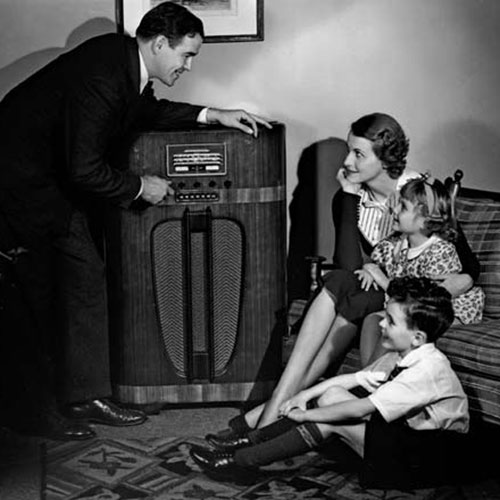
Before Television, Radio was the dominant home entertainment medium.

Old Time Radio (OTR) and the Golden Age of Radio refer to a period of radio
programming in the United States lasting from the proliferation of radio broadcasting in the early 1920s until television's replacement of radio as the dominant home entertainment medium in the late 1950s. During this period, when radio was dominant and the airwaves were filled with a variety of radio formats and genres, people regularly tuned in to their favorite radio programs. In fact, according to a 1947 C. E. Hooper survey, 82 out of 100 Americans were found to be radio listeners.
Origins
Radio content in the Golden Age of Radio had its origins in the theatrophone
. Broadcasting began in the 1880s and 1890s with audio recordings of musical acts and other vaudeville. These were sent to people by means of telephone and, later, through phonograph cylinders and discs. Visual elements, such as effects and sight gags, were adapted to have sound equivalents. In addition, visual objects and scenery were converted to have audio descriptions.  On Christmas Eve 1906, Reginald Fessenden is said to have broadcast the first radio program, consisting of some violin playing and passages from the Bible. While Fessenden's role as an inventor and early radio experimenter is not in dispute, several contemporary radio researchers have questioned whether the Christmas Eve broadcast took place, or whether the date was in fact several weeks earlier. The first apparent published reference to event was made in 1928 by H.P. Davis, Vice President of Westinghouse, in a lecture given at Harvard University. In 1932 Fessenden cited the Chistmas Eve 1906 broadcast event in a letter he wrote to Vice President S.M. Kinter of Westinghouse. Fessenden's wife Helen recounts the broadcast in her book Fessenden: Builder of Tomorrows published in 1940, eight years after Fessenden's death. The issue of whether the 1906 Fessenden broadcast actually happened is discussed in Halper and Sterling's article "Seeking the Truth About Fessenden"[1] and also in James O'Neal's essays.[2] [3] An annotated argument supporting Fessenden as the world's first radio broadcaster was offered in 2006 by Cambridge University educated Dr. John S. Belrose, Radioscientist Emeritus at the Communications Research Centre Canada, in his essay entitled "Fessenden's 1906 Christmas Eve broadcast." (Read More)

NEW SHOWS

ALIEN WORLDS

DR SIX-GUN

THE BEST OF SUSPENSE

FRANK LOVEJOY COLLECTION COUPLE NEXT DOOR TIME AND TIME AGAIN LET GEORGE DO IT

JEAN SHEPHERD 6 DVDs VIDEO COLLECTION - 10 TV MOVIES AND SHOWS
A Collection of Jean Shepherd TV movies and shows that portray a more innocent era when life was good, fun was clean, and station wagons roamed the Earth.
The Phantom Of The Open Hearth (1976)
Jean Shepherd Live at the Clinton Museum (1977)
Jean Shepherd's Pie (1977-1978) 5 episodes:
December 29, 1977 - January 13, 1978 - January 31, 1978 February 24, 1978 - March 27, 1978
Greenwich Village Sunday (1960s)

The Great American Fourth of July and Other Disasters (1982)
The Star-Crossed Romance of Josephine Cosnowski (1983)

Sign up for One's Media
Old Time Radio Newsletter:

* Email
 First Name
 Last Name
  * = Required Field
 
Your IP Address is: 54.234.67.55
Copyright © 2013 ONE'S MEDIA. Powered by Zen Cart